
Winery Crack Injection | Leaks Sealed with SealBoss Water Stop Foam
Another
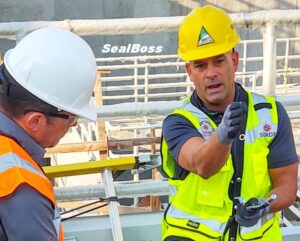
Injection Training
Boutique Winery | Leaks Sealed
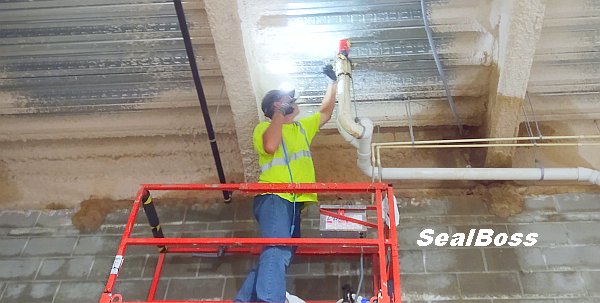
SealBoss Technical Rep Sealing Leaks In Missouri
Leaks can happen anywhere, and Wine Cellars are no exception.
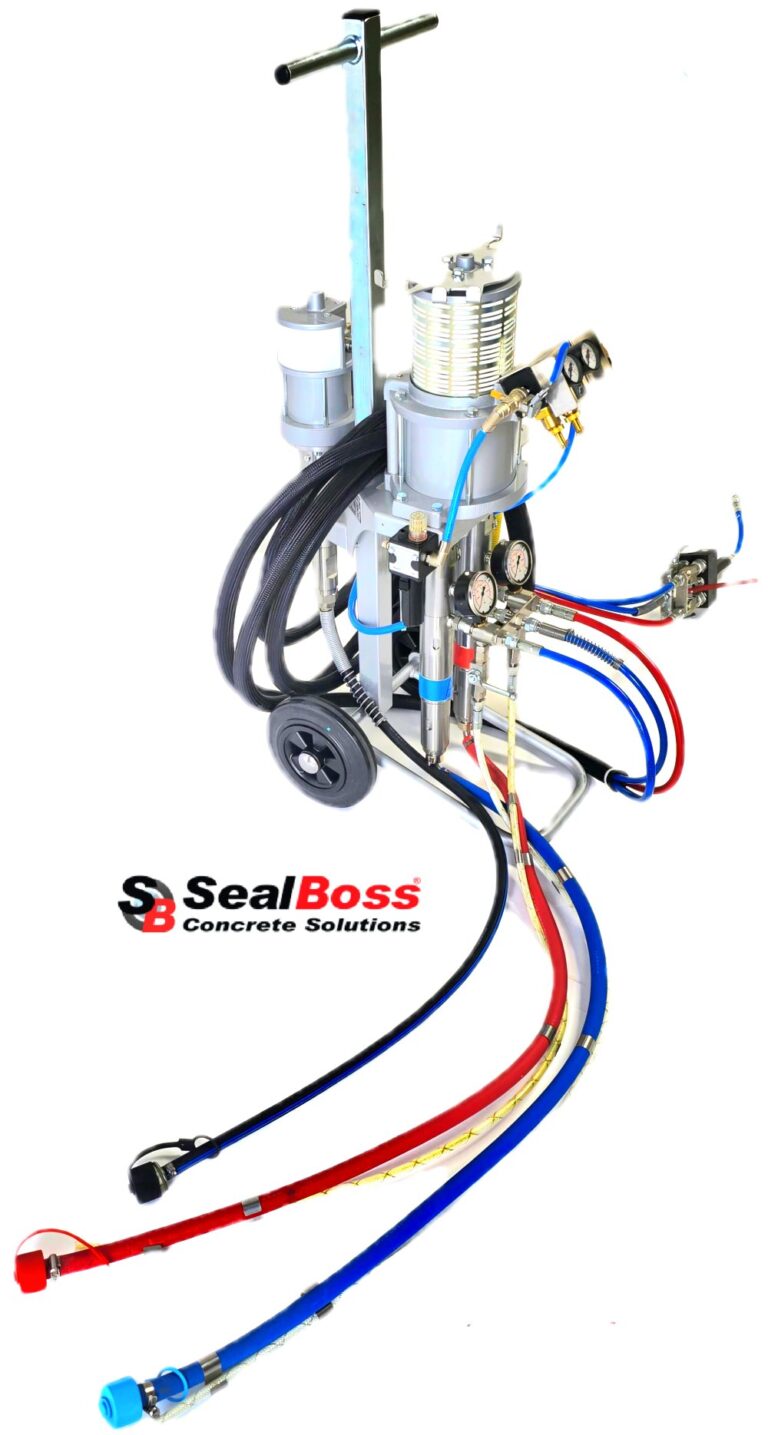
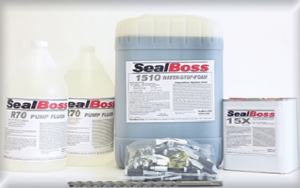
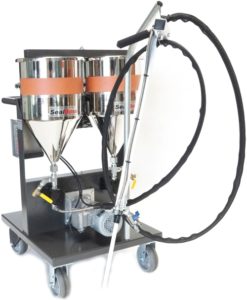
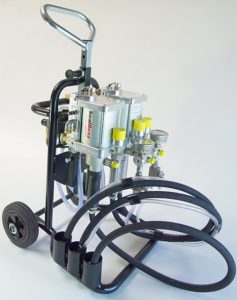
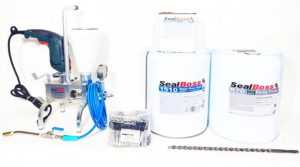
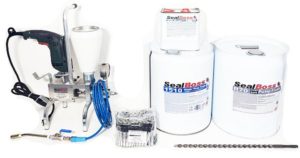
A local SealBoss Rep was called out to consult on a leaky cellar to demonstrate high pressure injection using the SealBoss P2002 Injection Pump and 1510 NSF Certified Water Stop Foam.
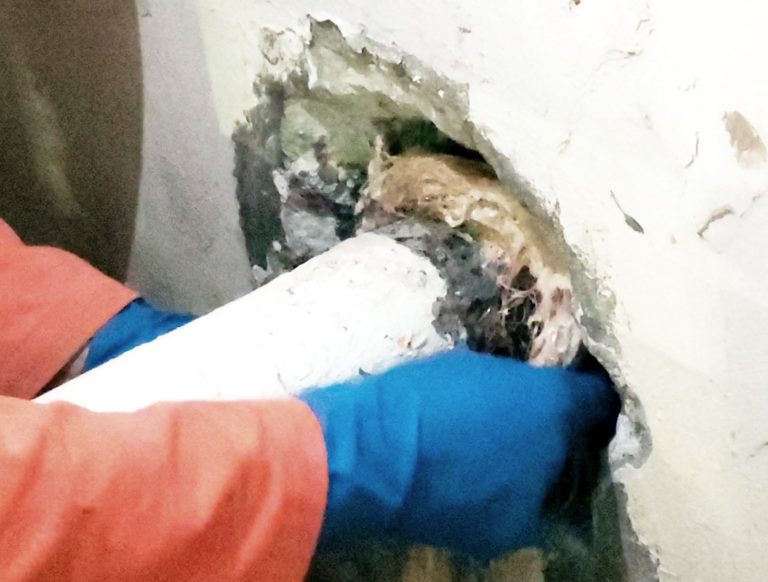
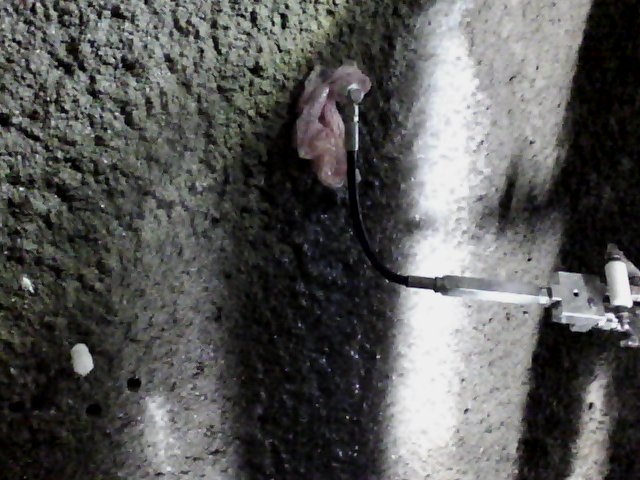
The wine cellar was a renovated below grade structure with a deck/extended porch above. The main source of the leak was a pipe penetration and adjacent crack where mastic crystalline grout had failed.
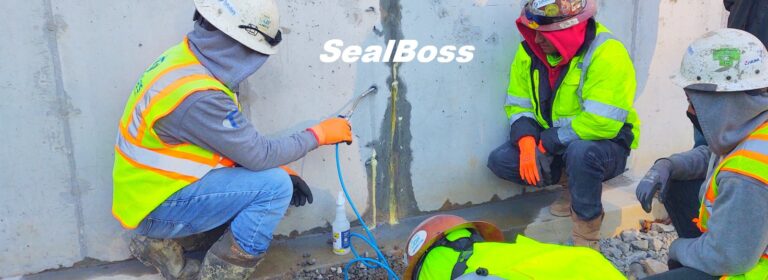
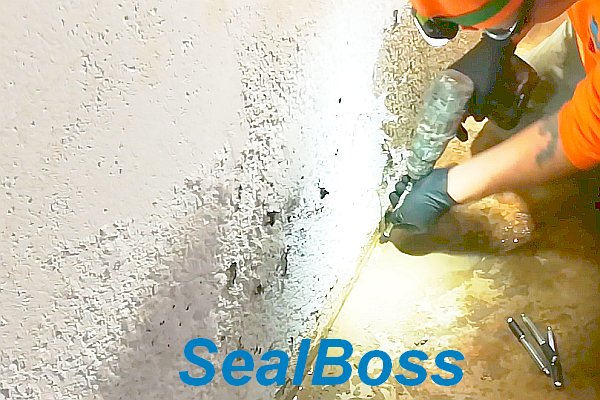
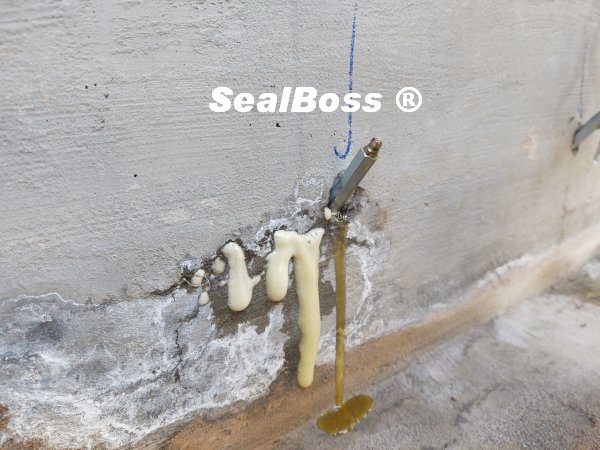
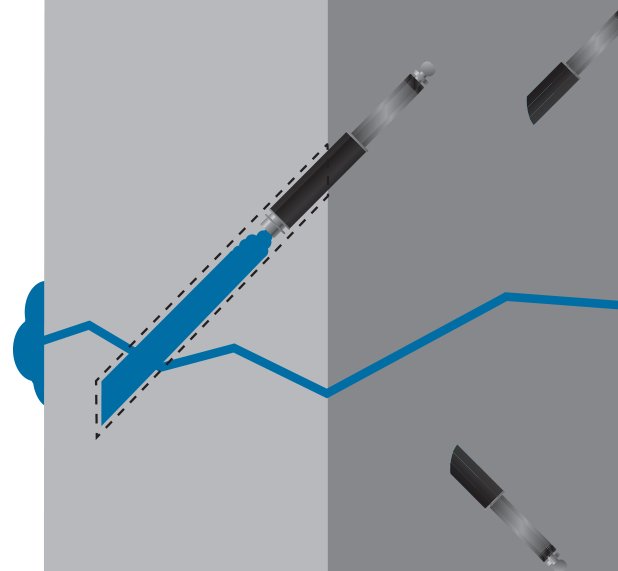
The repair began by cleaning the area with a wire brush to remove the failed grout down to the concrete. After the area was sufficiently exposed, the crack was clearly visible. A ½” hole was drilled and the SealBoss 13-100AL Evolution packer was then installed and injection with SealBoss 1510 Water Stop Foam began.
Injection continued till the void around the pipe penetration and the crack were filled. The packers were removed and followed by a 5 minute cleaning of the equipment with xylene and followed by SealBoss R70 Pump Flush.
Boutique Winery Eastern Missouri
“We Provide Field Service When You Need It!
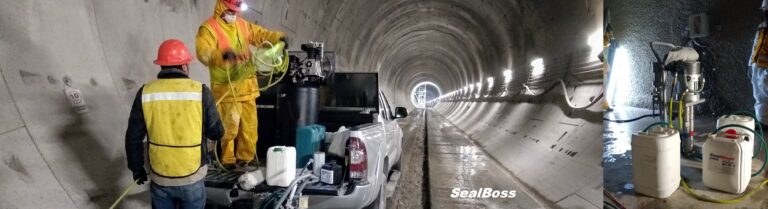
We have been offering experienced and responsive technical support since 1988. While providing on-site support and training, I create a positive learning environment focusing on building applicator confidence allowing for successful repairs to be continued after the training. From training new companies and their employees, SealBoss has continued to provide support to our clients for over 35 years.
We won’t leave a jobsite till I know everyone is comfortable with the SealBoss Systems.
Our knowledgeable technical support team is here to help with any questions you may have”
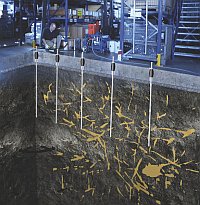
SealBoss ® 1510 NSF Water Stop Foam for infiltrating water:
- Water Stop Leak Repairs | Crack & Joint Leak-Seal | Soil Stabilization | Permeation Grouting
- Defective Concrete (Cracked or Honeycombed)
- Concrete Construction Joints & Cracks
- Brick Construction, Geo Formations
SealBoss ® 1510 NSF Water Stop Foam Advantages:
- Advanced NSF Formulation
- Up to 40+ Times Expansion
- SealBoss ® Product-Pump-Packer System Kit Solution
- Unregulated For Transport
- Solvent Free MDI Technology
In Person and Video training is available upon request, contact SealBoss today to speak to your regional technical representative on our SealBoss full system solutions and offerings.
Elevator Pit Repair | How To Stop and Seal Active Water Leaks – Podcast
Elevator Pit Repair
How To Stop and Seal Active Water Leaks
Technical Podcast for the Infrastructure Repair Industry
Elevator Pit Repair with Chemical Grouts
A Conversation Between Two Industry Professionals
Our guest today
Jim Andres, President
American Restore
Your host: Chris Coderre, SealBoss Corp.
Introduction
Welcome to another episode of our Technical Podcast for the Infrastructure Repair Industry, where we explore elevator pit repair and methods for stopping active water leaks with chemical grouts. Our guest brings over three decades of experience in specialized waterproofing, sharing valuable insights into the complexities of elevator pit repairs. We’ll discuss the use of various grout chemistries, equipment considerations, and techniques for adapting to unique repair challenges.
Join us for an in-depth conversation on delivering quality solutions while balancing cost-effectiveness and project demands.
In this episode, Jim shares his experience with the many aspects of elevator pit repair.
” …You know, sometimes you have to use different chemistries. We’re lucky that we’ve been doing it a long time. So we got all kinds of weird equipment for multi ratio and stuff and then we’ve got guys that have been doing it a long time. We give the techs the tools and the chemistry and they go out and attack these things. … “
“…You have to be sensitive to the owners wallet…”
Thank you Jim for being a guest on our show!
About
Jim Andrews
“With over 30 years of innovative specialty contracting that ranges from the basics of concrete construction and repair to highly specialized and exotic waterproofing methods, Jim Andrews has cultivated extensive experience with a wide variety of project types. Jim is highly experienced in all aspects of shot blasting and related concrete reparation for specialty topping, coating and waterproofing systems, with extensive knowledge of all types of concrete restoration methodologies, specialty floorings, coatings, injection and all aspects of grouting. His specialized training, knowledge, and hands-on experience have included projects in civil, industrial, public and private construction improvements with field investigations featuring bonded overlays, topping systems, and heavy public and private sector industrial slabs.”
About
American Restore, Huntington Beach, CA
“American Restore is a specialty contractor with over 30 years of experience in the waterproofing and repair industry. No matter the project, no matter the size, we believe in always pursuing quality and excellence on all our projects. Because of this belief, customer service and attention to detail are our key principles. From the initial product selection, through the design process and installation, to the finished product, American Restore is committed to working with you and your organization to provide the highest quality and most cost-effective solution to your waterproofing problems.”
Thermography | Measuring Effectiveness of Chemical Injection Grouting
Thermography - Chemical Injection Grouting
Infrared Thermography: Fast and Reliable Assessment of Chemically Grouted Shotcrete Structures
Chemical grout injection is a common method for concrete crack and water infiltration repair of concrete structures. During the process, a chemical mixture is injected into the ground or structure, resulting in an exothermic reaction that releases heat. This heat can be detected using thermographic imaging equipment, which can discern the relative differences between thermal masses or thermal capacities in grouted and ungrouted areas of the structure.
Non-Destructive and Non-Invasive Testing
Infrared thermography is an effective tool for providing a color picture that indicates the differences in energy or heat emitted from the surface of a structure. This image can assist in providing a quality assessment of the grout injection procedure, including the penetration, travel, and effectiveness of the grout. Additionally, thermographic imaging can also be used to monitor the curing process of the grout and detect any potential defects or anomalies.
Thermography | Measuring Effectiveness of Chemical Injection Grouting
Thermographic imaging has become an essential tool for many industries, including construction and engineering, as it provides a non-invasive and non-destructive method for evaluating the condition of structures. With the ability to detect heat and energy emitted from a structure, thermographic imaging can identify areas of concern and help prevent potential failures.
SealBoss, with over three decades of experience in the concrete repair industry, has made significant strides in developing materials and procedures for achieving effective and long-lasting chemical grout placement.
Despite this progress, confirming proper grouting through non-destructive means has remained a challenge for quality assurance purposes. The adoption of infrared thermography (IR) as a monitoring tool can aid in detecting and measuring product permeation and travel in grouted concrete and shotcrete structures for quality assurance.
Thermal Imaging | Shotcrete Grout Injection
Shotcrete is gaining popularity in below-grade construction. The trend of using shotcrete in lieu of traditional cast-in-place (CIP) concrete can be accredited to lower overall construction cost and time saved by not having to install formwork.
However, the use of shotcrete can result in a less than solid structure and may exhibit segregation, honeycombing, voids and air pockets which consequently leads to a higher incidence of water ingress in below-grade structures.
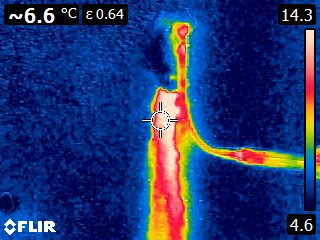
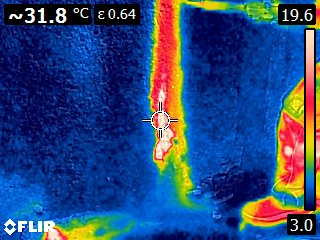
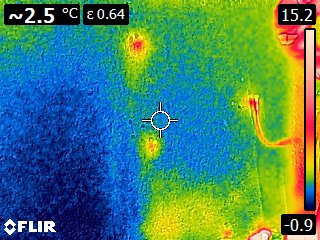
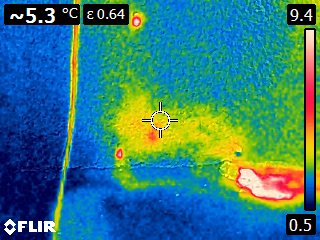
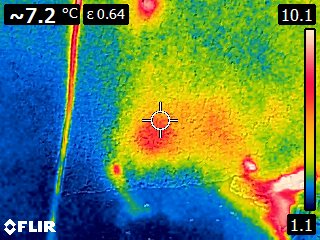
Thermographic Images: Shotcrete Tunnel Injection with SealBoss 2400 Acrylate Gel
As the gel undergoes its exothermic reaction and spreads through pressure injection, it generates heat that is transferred to the surrounding substrate. The resulting increase in temperature can be detected and visualized through color graded infrared (IR) pictures and videos.
Thermal images captured by the camera demonstrate the injection gel penetrating the structure and gradually expanding, warming the shotcrete in the process.
Synopsis – Chemical Grouting Thermography
During the exothermic reaction of chemical grout injected into the structure, energy is given off in the form of heat.
This heat can be detected by thermographic imaging equipment. Infrared thermography is able to discern the relative differences between thermal mass or thermal capacity in grouted and ungrouted areas of the structure and provide a color picture indicating differences in energy / heat emitted from the surface of structure.
The interpretation of the image can assist in providing a quality assessment regarding the penetration, travel and effectiveness of the grout injection procedure.
Two Component Epoxy Applicator | Anti Return Valve System
How to Use
SealBoss Two Component Epoxy Applicator
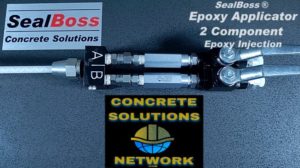
This SealBoss® Epoxy Injection Pump Two Component Applicator Gun is equipped with two high pressure quality shut-off ball valves and two anti return valves to prevent material backflow. The applicator system is designed for use with Plastic Static Mixers of various dimensions.
Contact Your SealBoss ® Technician
What Is Dynamic Cone Penetration Testing | SealBoss Deep-Soil-Lift

Dynamic Cone Penetrometer Soil Strength Test | DCP
What is Dynamic Cone Penetration ?
Dynamic Cone Penetration testing is a procedure utilizing a Dynamic Cone Penetrometer (DCP) to determine the geotechnical engineering properties of soils by measuring in-situ soil strength and recording the thickness and vertical location of subsurface soil layers of higher or lower density.
What is the difference between Dynamic Cone Penetrometer (DCP) testing and Cone Penetrometer Testing (CPT) ?
Dynamic Cone Penetration Testing is similar to the more elaborate CPT. In both procedures a metal cone is vertically driven into the ground to continuously measure soil behavior. Unlike in CPT, where the cone is driven into the ground at a constant rate by varying amounts of force, in Dynamic Cone Penetration testing the cone is driven by a standardized amount of force from a mechanical hammer.
Dynamic Cone Penetration testing | Portable & Affordable
Dynamic Cone Penetration testing is performed with an efficient, very effective, less expensive and much smaller system than CPT. Basic DCP equipment is portable and permits soil testing to depths of several feet – this makes it a good choice for soil testing prior to slab lifting and polyjacking applications.
Dynamic Cone Penetration testing (DCP) | Equipment
The DPM 30 penetrometer, an affordable and portable system, is equipped with a 30 kg (66 pound) hammer with a 200 mm (7.87 inch) stroke and operated by a hydraulic motor. It is driven by either an electric or gas powered motor-pump unit. A hydraulic extractor is used to extract rods, lining tubes and samplers. The penetrometer is pedal-operated.
To measure soil density, the operator simply counts the number of blows it takes to drive the steel cone in ten centimeter increments. Typically, soil strength of sufficient density requires 1 hammer blow per centimeter or 10+ blows of the hammer to drive the cone 10 centimeters deeper.
In order to determine soil strength prior to a polymer lifting job, multiple tests should be performed, spread out evenly over the area up to a predetermined depth or to refusal when hammer blows no longer cause measurable movement. The test results will determine where potential weak soil conditions may be present and soil stabilization procedures can be performed to address weaker layers accordingly.
Please don’t hesitate to contact us here at Sealboss for more information about our extensive injection products, as well as recommended soil testing equipment. Your representative will be happy to assist.
Zerk Coupler | Button Head Slide Coupler
SealBoss Quick Take
Couplers for Mechanical Injection Packers
Secure Fit / High Pressure Injection Couplers for Mechanical Packers and Ports
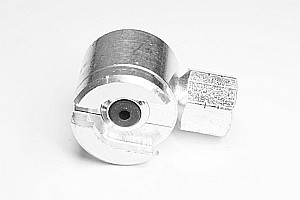
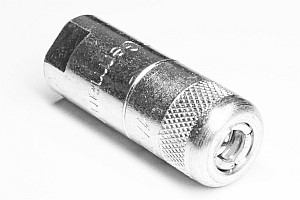
SealBoss ® Packer Connectors are designed to provide a secure and tight fit during injection. Both couplers have pressure activated ‘moving parts’.
The Zerk Type Coupler is equipped with four prong/claws that push forward and strengthen grip with increasing injection pressures.
The Button Head Slide Coupler features a rubber seal that expands under pressure, and thus creating a compression seal in conjunction with the fitting of the injection packer.
Couplers are an important injection accessory often overlooked in their importance. Please always keep your couplers free of debris and in good mechanical working order.
Our Zerk Couplers and Button Head Slide Couplers have been designed to securely connect your grout injection line to the injection packer even under high injection pressures.
The standard Zerk Coupler with 4 prongs works well in most crack injection scenarios. It connects and disconnects quickly while providing a tight connection under pressure.
The Button Head Slide Coupler provides another level of security by sliding over the button head of the packer. Even a pull on the injection line will keep the connector in place. The connector does not always have to be held by the applicator. We recommend the slide coupler as an alternative to the standard zerk coupler for applications such as commercial tunnel jobs, overhead injection and single applicator injection.
The slide coupler is used with Plastic Button Head Packers for large volume injection such as curtain injection behind structures and slab lifting injection with plural component foam and pump systems.
Please keep your couplers clean and in good working order to keep your connection free of leaks and to maximize your positive injection experience.
Please don't hesitate to contact us here at Sealboss for more information about our extensive packer selection. Your representative will be happy to assist.
We provide on-site support and training for all SealBoss System Solutions.
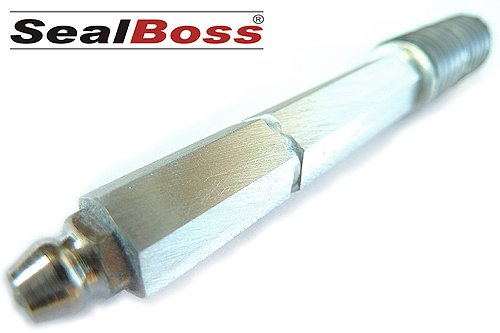
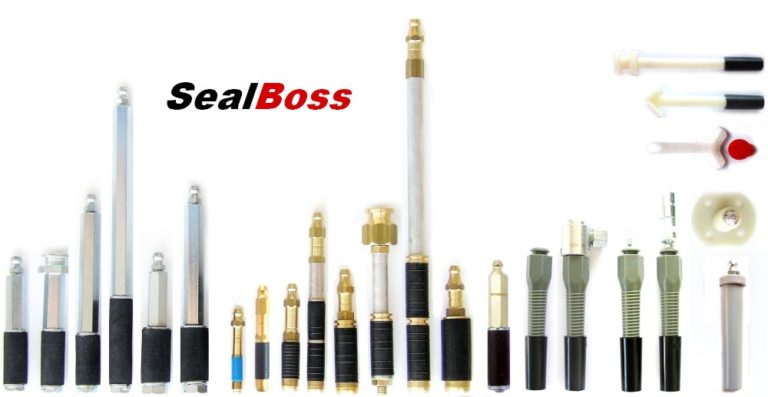
Brass Injection Packers
Brass Injection Packers by SealBoss ®
- Quality Brass Construction for Secure Fit Under Injection
- Extremely Wide variety in Diameters and Lengths
- Monolithic Zerk Fitting Integrated in Packer Design
- Anti Return Valve in Shaft Base
- Defined Breaking Point Lines
- Suitable for All Injection Resins
- A SealBoss Economic Packer | Millions sold
SealBoss ® Brass Mechanical Packer Advantages
Why should I use Brass Injection Packers ?
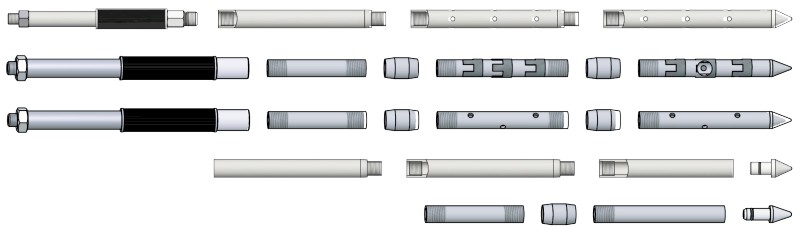
SealBoss ® Brass mechanical injection packers cover the needs for many specialty applications where extreme packer dimensions are required. Very small packers are often needed to inject into grout lines between tiles. Very long packers are needed to carry the resin beyond a void such as found in some hollow block walls.
Brass injection packers are an economic alternative to steel injectors. The brass design permits high tightening forces for good friction between the expanded rubber sleeve and the concrete substrate.
What is the Advantage of Anti Return Valve Placement in the Shaft ?
On some jobs the packer necks are broken off with a hammer. For this purpose the packers are designed with defined breaking point lines. Any uncured resin still residing in the drill hole will be held back by the anti return valve in the stem even if the packer neck and zerk portion of the packer has been removed.
The B-Type Brass Packers have you covered for specialty injection needs and situations where extreme sizes and lengths are required. From very small and thin to very long and large we typically have the right brass packer for you on the shelf. For even more extreme needs we also custom make packers as neccessary.
The brass construction is an economic alternative to the steel packers.
Please don't hesitate to contact us here at Sealboss for more information about our extensive packer selection. Your representative will be happy to assist.
We provide on-site support and training for all SealBoss System Solutions.
Super Low Viscosity Epoxy | Cartridge
How to Use SealBoss 4050 SLV Super Low Viscosity Epoxy Cartridges
SealBoss 4050 SLV is a 2-component, 100 % solids, high-strength, super low-viscosity, moisture-tolerant epoxy resin. This very thin injection epoxy is a concrete crack healer and deep penetrating crack sealer adhesive designed for high strength repairs in concrete substrates with fine and hairline cracks and fissures. SealBoss ® 4050 SLV Epoxy Resin meets ASTM C-881/ AASHTO M-235, Types I, II, IV, V Grade 1, Classes B & C.
- Dual Cartridges
- Quick & Simple Application – No Costly Equipment Needed
- Super low viscosity & lower surface tension for excellent penetration
- Prolongs life of cracked concrete structures
- Stronger than concrete
Today I like to talk about the SealBoss 4050 SLV Super Low Viscosity Epoxy Resin Cartridge System.
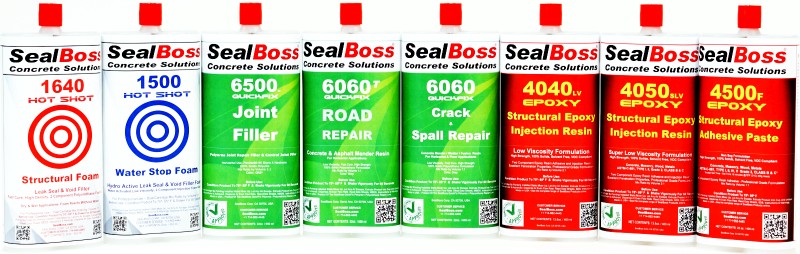
SealBoss offers professional grade products in dual cartridges as a convenient alternative to bulk products and elaborate equipment and machinery on smaller jobs where a limited amount of product is needed. Product is easily dispensed with a low cost epoxy cartridge gun.
For best results we recommend that you to follow a few simple guidelines and cartridge/product conditioning techniques prior to application.
Condition the cartridge to room temperature in colder climates. Shake cartridges prior to use. Push out any air by moving product through the static mixer while holding cartridge in an upright position. Dispense and discard a small amount of product into a dedicated vessel. Now your cartridge is primed and ready to go.
Inquire more about the SealBoss Cartridge System when you call us here at SealBoss. Your representative will be happy to help you out.
Based in Southern California, I personally provide support and training in the West U.S. and West Canada.
Contact Your SealBoss ® Technician
Epoxy Cartridge | Multi Purpose Adhesive
How to Use SealBoss 4040 LV Epoxy Resin Cartridges
SealBoss 4040LV is a 2-component, 100 % solids, low-viscosity, high-strength, multi-purpose, moisture-tolerant, epoxy resin adhesive designed for high strength repairs, epoxy injection and epoxy crack injection in concrete substrates such as floors, ceilings, walls, foundations and more. It meets ASTM C-881 and AASHTO M-235 specifications.
- 22 oz Dual Cartridges
- Quick & Simple Application – No Costly Equipment Needed
- Low viscosity – Deep penetrating and tenacious bonding in structural concrete
- Stronger than concrete
Today I like to talk about the SealBoss 4040 LV Epoxy Resin Adhesive Cartridge System.
SealBoss offers professional grade products in dual cartridges as a convenient alternative to bulk products and elaborate equipment and machinery on smaller jobs where a limited amount of product is needed.
For best results we recommend that you to follow a few simple guidelines and cartridge/product conditioning techniques prior to application.
Condition the cartridge to room temperature in colder climates. Shake cartridges prior to use. Push out any air by moving product through the static mixer while holding cartridge in an upright position. Dispense and discard a small amount of product into a dedicated vessel. Now your cartridge is primed and ready to go.
Inquire more about the SealBoss Cartridge System when you call us here at SealBoss. Your representative will be happy to help you out.
Based in Southern California, I personally provide support and training in the West U.S. and West Canada.