
Industrial Concrete Floor Repair: Where Polyurea Fits
A damaged control joint, a random crack, and a surface spall may appear in the same traffic lane. That does not make them the same repair.
When an industrial floor begins to break down, the first instinct is often to ask which product will fix it. A better starting point is to ask what has actually failed.
Is the opening a planned joint or an uncontrolled crack? Is concrete missing, or is the slab still moving? Does the repair need to support joint edges, rebuild damaged concrete, or address a deeper condition beneath the slab?
Those questions matter because industrial concrete floor repair is not a one-material job. A semi-rigid polyurea joint filler serves a different purpose from a rigid material used to rebuild a spalled edge. Neither will correct settlement, active water pressure, or an unstable slab.
Polyurea Floor Repair Is Not a Floor Coating
Search for “polyurea floor repair,” and many results lead to full-surface garage or commercial floor coatings. That is not the type of repair discussed here.
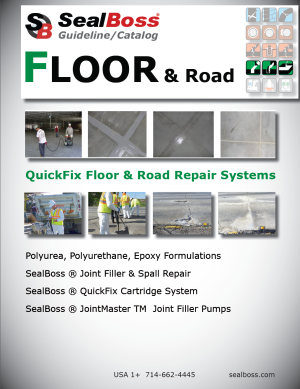
Localized industrial floor repair addresses defined areas of damage, including control and construction joints, random horizontal cracks, spalled joint edges, pop-outs, holes, deteriorated joint filler, and damage in forklift or vehicle traffic lanes.
A coating covers a broad floor surface. A localized repair addresses a particular defect. That distinction affects material selection, concrete preparation, dispensing equipment, repair geometry, finishing, and return-to-service planning.
How to Diagnose Concrete Floor Damage Before Choosing a Product
Visible damage provides useful clues, but it does not always reveal the complete cause. A crack may be stable or still moving. A broken joint edge may result from hard-wheel impact, weak concrete, an unfilled joint, or slab movement. Separated filler may point to continued shrinkage, moisture, inadequate preparation, or a material that did not match the joint condition.
| Observed floor condition | Question to ask first | General repair direction |
|---|---|---|
| Saw-cut control joint | Does the joint need edge support under wheeled traffic? | A semi-rigid joint filler may be appropriate |
| Construction joint | Are the joint walls sound, clean, dry, and ready to receive filler? | Evaluate the joint-filling system |
| Random horizontal crack | Is the crack stable, or is movement continuing? | Determine whether rigid or flexible behavior is required |
| Surface spall or pop-out | Does missing concrete need to be rebuilt? | Evaluate a rigid repair material |
| Broken joint shoulder | Must the concrete edge be reconstructed before the joint is filled? | Repair the damaged concrete first |
| Existing filler separation | Is the cause shrinkage, movement, moisture, preparation, or geometry? | Inspect before removing and replacing |
| Expansion or isolation joint | How much movement must the joint accommodate? | Confirm the appropriate movement-joint system |
| Rocking, settlement, active water, or widespread cracking | Is a larger slab, support, or water condition involved? | Investigate before making a localized repair |
This table provides general orientation rather than a project-specific recommendation. Movement, moisture, substrate condition, temperature, repair depth, traffic, and finish requirements can all change the appropriate repair approach.
Joint Filling and Concrete Rebuilding Are Two Different Repairs
One of the most useful distinctions in industrial floor repair is the difference between filling a joint and rebuilding damaged concrete.
Semi-Rigid Joint Filling
A semi-rigid joint filler is installed in a prepared joint or appropriate crack. In the right application, it helps support the vertical concrete edges as wheels cross the opening.
Rigid Concrete Rebuilding
A rigid repair material is used where concrete is missing, fractured, or deteriorated, such as a surface spall, broken joint shoulder, hole, pop-out, or stable crack requiring a rigid repair.
Some floor repairs need both. A damaged joint edge may first need to be rebuilt with a rigid repair material. Once the concrete has been restored and the joint geometry re-established, the opening can be filled with a material chosen for the joint’s intended behavior.
The two materials may meet within the same repair area, but they are not performing the same function.
SealBoss 6500 QuickFix
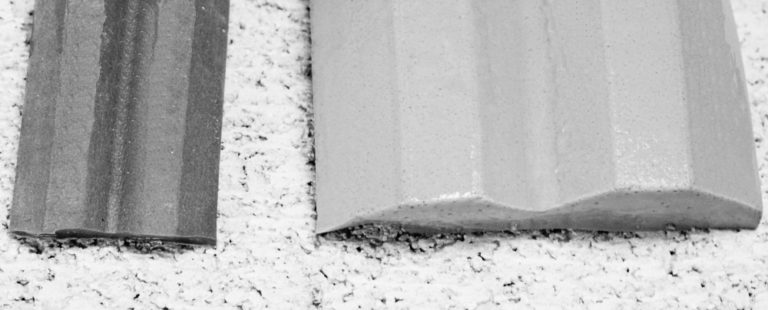
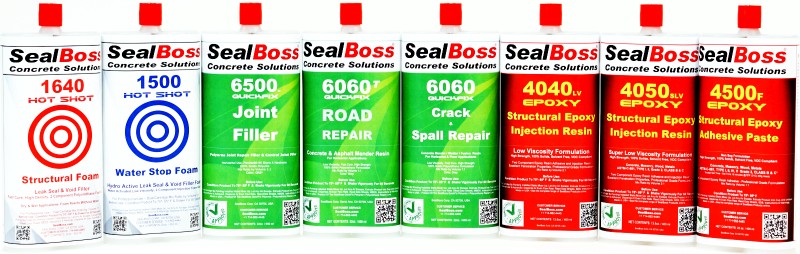
SealBoss 6500 QuickFix is a rapid-setting, self-leveling, two-component polyurea joint and crack filler for concrete substrates. Its stated applications include horizontal cracks, control and construction joints, and industrial floors exposed to hard-wheel or vehicle traffic.
In an appropriate joint-filling application, SealBoss 6500 QuickFix helps support the concrete edges as traffic crosses the opening. That makes the system relevant to warehouse floor joint repair, distribution centers, manufacturing floors, cold-storage facilities, and other concrete floors exposed to wheeled equipment.
Selection depends on the joint type, anticipated movement, moisture, temperature, repair geometry, traffic, and required finish. The technical documentation calls for a dry repair area and dry dispensing equipment and excludes cracks and joints under hydrostatic pressure or with extreme movement.
Fast-setting behavior can be valuable in an active facility, but cure speed alone does not determine whether a material belongs in a particular joint.
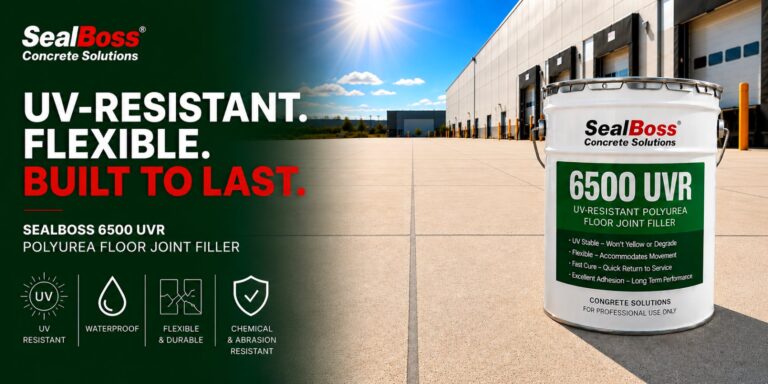
SealBoss 6500 UVR: When Joint Appearance Matters
The appearance of a finished joint may also matter, especially on polished floors or near exterior openings where sunlight can affect the way a repair looks.
SealBoss 6500 UVR provides an option within the polyurea joint-filler system where UV-related color stability is relevant. Joint function, movement, substrate condition, and installation requirements still control the overall selection. UV resistance should not be interpreted as complete immunity from color change under every exposure condition.
SealBoss 6060 QuickFix: Rigid Repair for Spalls and Damaged Concrete
SealBoss 6060 QuickFix serves a different repair role. Its Product Data Sheet identifies it as a rigid polyurethane repair material designed for spalled concrete, horizontal cracks, holes, surface defects, and damaged control joints. It also directs users toward a flexible SealBoss product where movement is required.
This makes SealBoss 6060 QuickFix relevant when the objective is to rebuild or bond damaged concrete rather than fill a joint that requires semi-rigid behavior.
For suitable repair geometries, the material may also be used with approved, dry, nonreactive aggregate. Aggregate selection, proportions, repair depth, preparation, and finishing must follow the SealBoss technical instructions.
SealBoss 6500 QuickFix
Fills joints and appropriate cracks where semi-rigid support is needed.
SealBoss 6060 QuickFix
Addresses rigid cracks, spalls, holes, damaged shoulders, and surface defects.
Choosing between them begins with understanding what the completed repair must do.
Control Joint Repair Versus Expansion Joint Repair
Not every straight opening in a concrete floor is intended to behave the same way. Control, construction, isolation, and expansion joints are created for different reasons. Their expected movement and relationship to the surrounding slab influence how they should be treated.
Before filling a joint, determine whether it was formed or saw cut, whether it separates slabs or structural elements, whether movement is expected, and whether the concrete edges remain sound. An opening that has widened, old filler, water, contamination, or vertical displacement may also affect the repair approach.
A control joint intended to guide shrinkage cracking should not automatically be treated like an expansion or isolation joint intended to accommodate broader movement. When the joint function or movement requirement is unclear, technical or design-professional review may be necessary.
Speed and Spec Sheets Do Not Replace Diagnosis
Active facilities often have limited repair windows. The work may need to fit into one shift, a weekend shutdown, or a production changeover.
Rapid-setting materials can provide a practical scheduling advantage when their reaction and cure profile matches the repair conditions. But speed does not answer the most important questions: Is the opening a joint or a crack? Is movement continuing? Is the concrete sound? Is the repair area dry? Does the repair need semi-rigid, flexible, or rigid behavior?
The same caution applies to individual specification values. A laboratory elongation result, for example, does not by itself establish how much movement an installed joint can accommodate. Material hardness, joint dimensions, bond condition, concrete strength, temperature, moisture, slab shrinkage, and traffic also influence installed behavior.
Diagnose the condition. Select the repair role. Then plan the installation window.
Surface Preparation Controls the Repair
Rapid-setting material cannot compensate for contaminated or unsound concrete.
Oil, tire rubber, concrete dust, loose material, moisture, weak joint shoulders, and debris can interfere with the repair. Problems may also result from off-ratio dispensing, cured material inside a static mixer, or equipment that has not been prepared for the chosen product.
SealBoss technical guidance calls for removing contaminants, exposing clean concrete, removing saw-cut dust, and keeping the repair area, pumps, and hoses dry. Preparation must match the product and repair geometry. The Product Data Sheet, Safety Data Sheet, application guidance, and equipment instructions remain the controlling field documents.
When Joint Filler Separates, Find the Cause First
When existing filler pulls away from one side of a joint, it is tempting to remove it and install new material immediately. That may not address the reason the joint opened.
Continued slab shrinkage, movement beyond the filler’s limits, moisture, contamination, weak concrete, installation geometry, or dispensing conditions may all contribute to separation.
Inspect the joint and surrounding slab before replacing the material. Otherwise, the same underlying condition may remain after the repair.
Repairing a Damaged Joint Edge
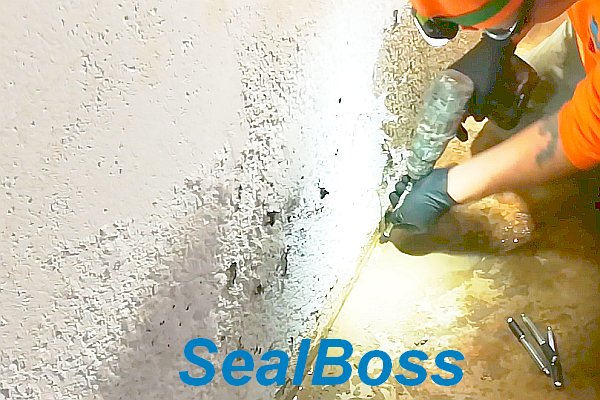
A deteriorated joint is not always just an empty opening. The shoulder may be rounded, fractured, spalled, or missing. Installing filler against unsound concrete can leave the primary defect unresolved.
- Identify why the joint edge deteriorated.
- Remove loose and unsound concrete.
- Establish sound repair boundaries.
- Rebuild the damaged concrete with an appropriate rigid repair material.
- Restore the required joint geometry.
- Fill the joint with a material chosen for its intended behavior.
- Finish and cure the repair according to the current technical instructions.
This sequence explains the repair logic. It does not replace SealBoss application guidance or project-specific review.
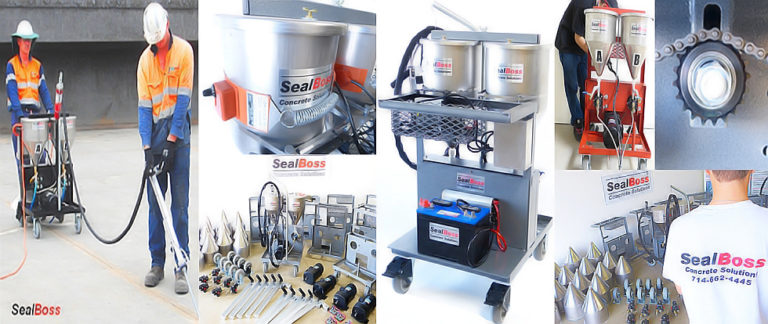
Cartridge or Bulk Floor-Repair Equipment?
The size of the repair program influences the dispensing system.
Cartridge Configurations
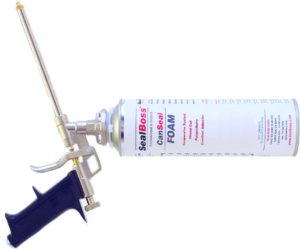
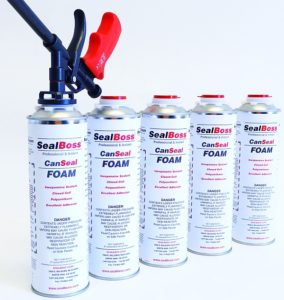
Cartridge systems can be practical for localized repairs, punch-list work, maintenance quantities, and sites where mobilizing larger equipment is not justified.
Bulk Configurations
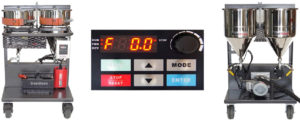
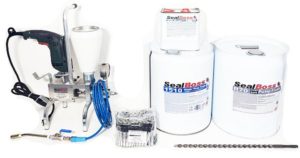
Bulk systems may be better suited to longer joint-filling runs, larger floor-repair programs, and repetitive production work requiring metered two-component dispensing.
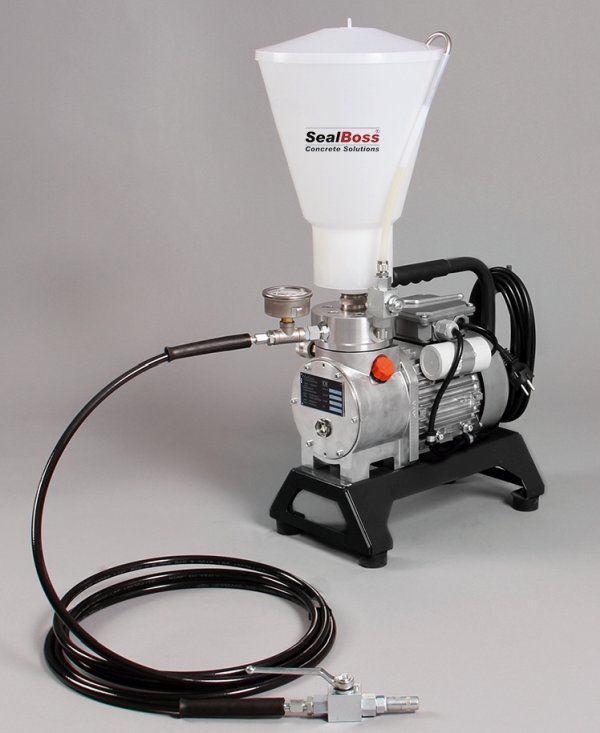
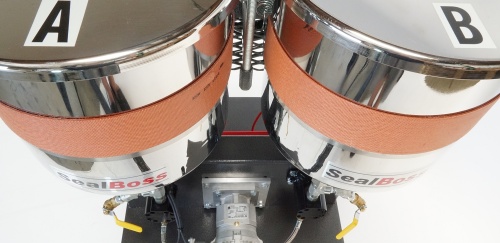
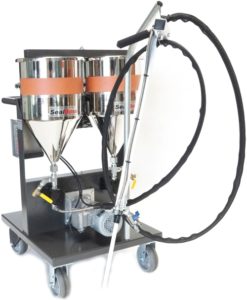
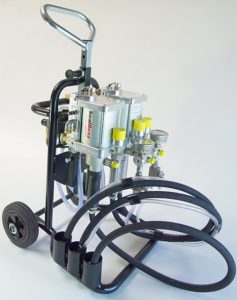
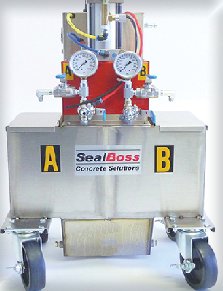
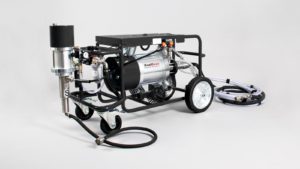
For compatible bulk applications, SealBoss JointMaster equipment connects the repair material to a dedicated two-component dispensing platform. Equipment compatibility should be confirmed for the exact material and configuration.
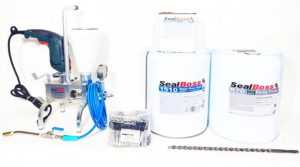
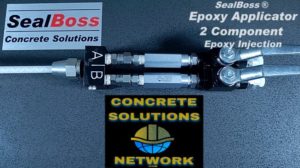
The product is only one part of the installation. A complete setup may also include a dual-component cartridge gun or metered pump, static mixers and applicators, joint-cleaning and preparation equipment, approved aggregate where permitted, finishing tools, cleaning and pump-conditioning materials, current documentation, and a crew familiar with the system.
The Practical Advantage of the SealBoss Floor Repair System
The SealBoss advantage is not a claim that one product solves every floor problem. It is the ability to connect different repair objectives with materials, dispensing options, accessories, training, and technical support.
When the Floor Needs More Than a Local Repair
Some conditions should not be treated as routine filling or patching.
Rocking or deflecting slabs, settlement, loss of support, repeated cracking, significant movement, active water, widespread deterioration, reinforcement corrosion, chemical attack, or vertical displacement may indicate a larger problem.
A localized polymer repair cannot correct unresolved slab support, structural movement, or water-pressure conditions by itself. These conditions may require additional technical or engineering review before a repair system is chosen.
Choose the Repair Role Before the Product
The most useful question is not, “Should we use polyurea?”
It is: “What must the completed repair do under the actual floor conditions?”
For horizontal joints and appropriate cracks requiring a rapid-setting semi-rigid polyurea joint filler, review the SealBoss 6500 QuickFix system. Where UV-related color stability matters, review SealBoss 6500 UVR. For concrete spalls, holes, surface defects, damaged joint shoulders, and rigid crack-repair objectives, review SealBoss 6060 QuickFix.
Where active water, significant movement, slab instability, or structural concerns are present, confirm the repair approach before choosing a material.
Frequently Asked Questions
What is the difference between a control joint and an expansion joint?
A control joint is formed or saw cut to guide shrinkage cracking within a slab. An expansion or isolation joint separates concrete elements and is intended to accommodate broader movement. The two joint types should not automatically receive the same filler system.
Can polyurea joint filler be used for concrete spall repair?
A semi-rigid polyurea joint filler is not the material used to rebuild missing concrete. A spall, hole, or broken joint shoulder generally requires a rigid repair material suited to that condition. After the damaged concrete has been rebuilt and the joint geometry restored, the joint can be evaluated for filling.
Why did my joint filler separate from the concrete?
Possible causes include continued slab shrinkage, movement beyond the filler’s limits, moisture, contaminated or weak joint walls, improper installation geometry, or dispensing problems. Inspect the joint and surrounding slab before replacing the filler.
Should I use cartridges or bulk dispensing equipment?
Cartridges are commonly suited to localized and maintenance repairs. Bulk metered equipment can be more practical for longer joint runs and larger repair programs. Confirm compatibility between the exact material, mixer, applicator, and dispensing equipment.
This article provides general educational guidance and does not make a project-specific product or engineering determination. Review the current SealBoss technical documents and obtain appropriate technical or design-professional input for the actual project conditions.
Need Help Selecting the Right Floor-Repair System?
Discuss the joint, crack, spall, equipment requirements, and project conditions with a SealBoss technical representative.